
M5 - Learner Manual
4. Negotiate Resolution
4.3. Ensure negotiation styles take into account social and cultural differences
Culture profoundly influences how people think, communicate, and behave. It also affects the kinds of transactions they make and the way they negotiate them. Misunderstandings may arise during the process of negotiation due to a lack of cultural awareness and misunderstandings that may occur unintentionally.
Negotiating styles, like personalities, have a wide range of variation. The ten negotiating traits discussed above can be placed on a spectrum or continuum, as illustrated in the chart below. Its purpose is to identify specific negotiating traits affected by culture and to show the possible variation that each traitor factor may take. With this knowledge, you may be better able to understand the negotiating styles and approaches of counterparts from other cultures. Equally important, it may help you to determine how your own negotiating style appears to those same counterparts.
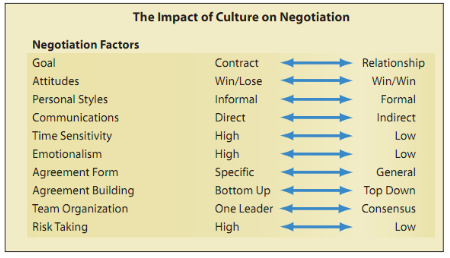
Source: Salacuse, J.W. (2006). Leading Leaders: How to Manage Smart, Talented, Rich and Powerful People, Amacom Books. Retrieved from http://iveybusinessjournal.com/topics/the-organization/negotiating-the-top-ten-ways-that-culture-can-affect-your-negotiation#.U-B8tbccRl8 (accessed on 5/8/14)
Strategies which respect culture
Strategies for resolving conflict should be found that respect culture. These may include:
consultative process
protecting individuals from shame
disciplining within the organisation
non-confrontational approach
using traditional methods if appropriate
Aboriginal and Torres Strait Islander mediation within Community Justice Centres[1]
Mediation for Aboriginal and Torres Strait Islander people has been a priority of the Community Justice Centres since the inception of the CJCs in 1983.
CJC has services to help Aboriginal and Torres Strait Islander people solve their disagreements. Aboriginal mediators are available to help you solve a wide range of conflicts. They can also come out to your community or group and talk to you about what mediation is and the types of services they offer.
[1] NSW Government. (2012). Justice Lawlink, Mediation for Aboriginal and Torres Strait Islander People. Retrieved from http://www.cjc.nsw.gov.au/cjc/com_justice_mediation/com_justice_mediation_atsi.html, accessed on 6 August 2014