
M5 - Learner Manual
4. Negotiate Resolution
4.2. Use communication techniques that are effective in ensuring mutual understanding
Consultative process
A consultative process for dealing with conflict is one where everyone involved in the conflict is brought together to discuss it. Everyone has a part to play in resolving the conflict in a consultative process.
If necessary, Elders or other respected members of the community may also be consulted on the best way of dealing with the conflict situation. This is essential in communities that still practice traditional ways.
In a consultative process, everyone is given a chance to tell their side of the story. This can be done in an informal way, by sitting down with the person and talking with them about what happened.
In a custodial setting there may be organisational training and policies in place that inform employees about how they should set about negotiating with somebody in a particular situation.
Of course employees must always comply with their organisational and legal requirements. It is important to be aware of these requirements. Usually an employee will sign an agreement as part of their employment contract that they will comply with these requirements.
There are some general principles that apply to most negotiating situations and can provide useful insights about how to approach a particular situation. The ‘conflict layer model’ provides some general information about how to understand and approach negotiating.
Clarifying Needs during Conflict Negotiations
|

When you were last involved in a negotiation (however big or small), did you feel that you truly understood the other person's needs? Chances are, you didn't.
During negotiations, it's common for people not to reveal their deepest needs – sometimes, even to themselves. They may feel selfish, foolish, or vulnerable talking about them, so they focus on less important issues instead.
Unfortunately, when this happens, the negotiation may not deliver a long-term solution, because it won't be based on what people really want.
The Conflict Layer Model is a tool that you can use to explore your own true needs in a negotiation situation. Using this technique can assist you to maintain a positive interaction and divert and minimise aggressive behaviour that may be present in a conflict situation.
About the Model
Figure 1 – The Conflict Layer Model
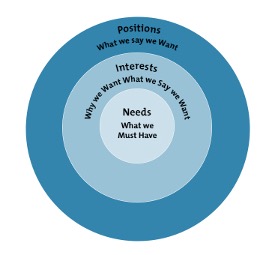
From "Working With Conflict" by S. Fisher et al. Published by Zed Books, 2000. Reproduced with permission.
During negotiations where you don't know or trust the other person, you may hide your needs because you feel embarrassed or vulnerable. Instead, you might take up a stance that's based on how you want to be perceived. This is known as your position.
Behind your position lie your interests. These are the stated reasons that support your position, but they may not represent your true needs.
The model aims to peel away these layers, and to focus on the needs that really matter to you. When you state your needs openly, it will encourage the other party to do the same. Then, once you've both identified and communicated your real needs, you can work to find a solution that meets them.
Note: This model is not suitable for all negotiations. It's more suited to situations in which people feel able to talk freely and openly, and it's less appropriate when people's needs must be hidden, or when people must be seen to "toe a party line."
In this situation, distributive bargaining may be more suitable.
Distributive bargaining is a process of incremental compromises resulting eventually in an agreement with which neither party is entirely happy. Such agreements are normally reached through a process of attrition, after parties become fatigued by the constant conflict and series of meetings and normally one of the parties will capitulate at the end for the sake of reaching an agreement.
The Conflict Layer Model most closely matches a collaboration strategy.
How to Apply the Model
You can use the model to prepare before negotiations begin, as well as to understand other people's needs during the negotiation. Follow the steps below to do your preparation. You can use a similar approach during the negotiation itself.
Step 1: Separate Your Position from Your Interest
Your position is the "want" that you have expressed publicly to the other party. You need to explore this to find your interests – what you want to achieve from this situation.
So, start by writing down what you have said you need, or what you think you want to achieve from this situation.
Next, list the reasons you've given to support your position. These are your interests. (If necessary, use the 5 Whys technique to explore why these issues or solutions are important to you.)
The 5 Whys is a repetitive question-asking technique used to explore the cause and effect relationships underlying a particular problem. The primary goal of the technique is to determine the root cause of a problem. (The "5" in the name derives from an empirical observation on the number of repetitions typically required to resolve the problem.)
Step 2: Identify Your Needs
Once you have identified your interests, your next step is to distil them further to discover your deeper needs. These are the needs you must meet to feel satisfied. Often, they are non-negotiable – you need to meet them for the negotiation to have been a success.
Think carefully about the interests that you have defined. Keep in mind that your interests are often a means to an end – they help you meet your needs. So, what basic or intrinsic needs do these interests help you address?
Then, be completely honest with yourself. Ask yourself if there are other, more self-interested or less easily discussed needs that you need to address as well.
Step 3: Negotiate
Your next step using the model is to state your needs clearly. When you do this, you create an atmosphere of trust that will encourage the other party to be open about their true needs.
Then, negotiate to meet your needs. Where appropriate, use win-win negotiation and integrative negotiation to explore solutions based on shared needs.
Integrative negotiation - to explore solutions, and "trade favours," so that both parties feel satisfied with the outcome.
The model helps you "peel away" the superficial positions that people often adopt at the start of a negotiation, so that you can get to the real substance of what they want. This helps you find a solution that meets the needs of everyone involved.