
M2 - Learner Manual
9. The Stolen Generation
9.1. The First Removals
By the 1890s, the Aboriginal Protection Board developed a policy of segregation. Armed with growing legal control over the lives of Indigenous people, the Board sought to remove children of 'mixed-descent' from their families. These children were later to be merged into the non-Indigenous population.
This policy was based on the idea that children could be 'socialised as Whites' and that 'Aboriginal blood' could be bred out. The authorities believed that if the number of 'half-castes' was growing in comparison to 'full-bloods', then gradually they would biologically assimilate into European society. This could only be achieved by separating 'full-bloods' from 'half-castes'.
The first homes were built for young Indigenous women, such as the one at Warangesda station built in 1893. Some 300 Indigenous women were removed from their families and housed at this station alone between 1893 and 1909. The Board relied on persuasion such as offering free rail tickets, and threats to remove the children.
In 1909, this legal power was granted. The Aborigines Protection Act 1909 gave the Board power 'to assume full control and custody of the child of any aborigine' if the court found the child to be neglected. It also allowed the Board to send Indigenous children aged between 14 and 18 years to work.
Given the ACT's location in regional NSW and the continuation of NSW administration, there was no real distinction between the ACT and the rest of NSW. The few Indigenous children who lived in the ACT also came under the control of the NSW Protection Board.
Five years later, the Board told all station managers that all 'mixed-descent' boys over 14 years must leave the stations to work. Girls over 14 years either had to work or be sent to the Cootamundra Training Home where they were trained in domestic services.
Even so, it was still difficult to implement the separation policy. For children under 14 years, the Board had to prove to a court that the child was neglected before they could be removed. This process often took a long time; often long enough for the family to leave the reserve or move to Victoria. The Board requested extended powers.
These were granted in 1915. Under these laws, the Board now had total power to separate children from their families without having to prove the child was neglected. In fact, no court hearings were necessary. The manager of an Aboriginal station or a policeman on a reserve or in a town could also order removal. The only way a parent could prevent the removal was to appeal to court.
A number of politicians strongly opposed this new law. The Hon P. McGarry said the laws allowed the Board 'to steal the children away from their parents'. Another referred to the laws as the 'reintroduction of slavery in NSW'.
Source: https://www.australianstogether.org.au/discover/australian-history/early-settlers/
The practices of forcible removal of Aboriginal children have a long history in this country virtually going back to colonisation, with first removal starting as early as 1800s,’with the opening of a school for Aboriginal children at Parramatta called the ‘Native Institution’ in 1814. This did not include the kidnapping that had also taken place. Today it is argued that child removal is at an even greater level than it was at the peak of assimilation (Larissa Behrendt).
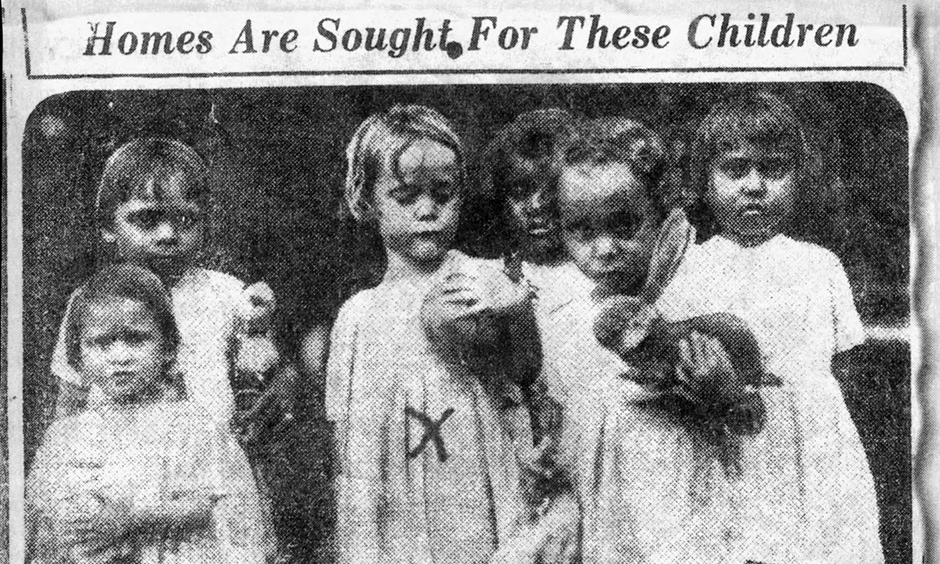
A 1934 newspaper clipping showing Indigenous children who have been taken from their families as part of the stolen generations. Photograph: Corbis
In 1995, the Commonwealth Attorney General established a National Inquiry into the Separation of Aboriginal and Torres Strait Islander Children from their Families, to be conducted by the Human Rights and Equal Opportunity Commission (HREOC). The Inquiry report, Bringing Them Home, was tabled in the Commonwealth Parliament on 26 May 1997.
On 18 June 1997, former NSW Premier the Hon. Bob Carr, issued a formal apology in response to Bringing Them Home. Premier Carr moved that NSW:
‘Apologises unreservedly to the Aboriginal people of Australia for the systematic separation of generations of Aboriginal children from their parents, families and communities’ and ‘acknowledges and regrets Parliament’s role in enacting laws and endorsing policies of successive governments whereby profound grief and loss have been inflicted upon Aboriginal Australians’.
On 13 February 2008, history was made when newly elected Prime Minister Kevin Rudd issued a formal apology to all Aboriginal and Torres Strait Islander peoples on behalf of current and successive Commonwealth Governments: