M2 - Learner Manual
11. Aboriginal Rights and Civil Rights
11.3. New Zealand
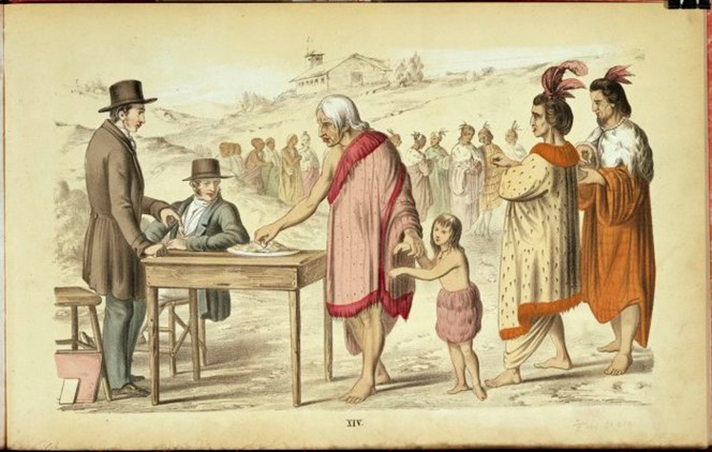
Photo: Artist Unknown 1856 New Zealand Treaty
Ref: PUBL-0151-2-014 Shows Veili, a white-haired Maori chief, placing a coin in a collection basket on a table, while Rev William Puckey and Rev Joseph Matthews look on. Veili holds a small child by the hand, and chief Pana-kareao and his wife stand in the right foreground, while a large group of Maori talk together in the background. The mission station at Kaitaia is on a slope in the background.
The Treaty of Waitangi was signed in 1840 and is New Zealand's founding document, instead of a constitution. Its signing is celebrated every year as the national holiday, in a similar way to Australia Day being celebrated here. The Treaty is often referred to in legislation and trade deals.
New Zealand was the only country out of the 12 Trans-Pacific Partnership (TPP) signatories to have an explicit carve-out for its treaty with the indigenous population, which meant the TPP could never override the Treaty of Waitangi.
The document was presented to 500 Maori chiefs by the first British resident in New Zealand, James Busby, but not every chief signed. Eighteen years after the treaty was signed, the government had the first of many battles with Maori tribes who did not recognise their authority.
There are two versions of the treaty, the English version gives more power to the British settlers than the version written in Maori. In article one of the British version, Queen Victoria has "sovereignty" over the land but the Maori version says she has "governance." Disputes under the treaty are still being settled today by the Waitangi Tribunal.